

Data Centres & AI: The Talent Powering the World's Fastest-Growing Infrastructure

Artificial intelligence has turned the data centre into the most contested asset class in the global economy — and the professionals who design, build, commission and run these facilities into some of the most sought-after people in engineering.
By STRAGO International -28 July 2026 - 10-minute read
Every AI application — from generative platforms and machine learning to advanced automation — ultimately rests on one physical foundation: the data centre. As demand for compute accelerates, investment in data centre development has moved from steady growth to an outright construction boom, and the competition for specialist engineering talent has intensified with it.
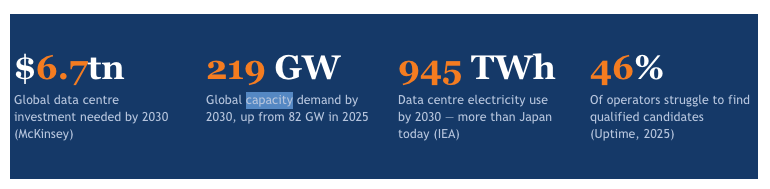
The scale is difficult to overstate. Analysts at McKinsey estimate that keeping pace with global demand for compute power could require close to US$6.7 trillion of data centre investment by 2030, of which roughly $5.2 trillion is tied specifically to AI workloads. Behind that capital sits a supply chain of engineers, project managers, electricians and commissioning specialists that the market simply does not yet have in sufficient numbers.
01 — The Growth Engine
The AI Revolution Is Rebuilding the World's Infrastructure
The adoption of AI has sharply increased the need for data processing, storage and cloud computing. Technology providers, financial institutions, healthcare organisations and governments are all investing heavily in digital infrastructure to support future growth. New projects are being launched worldwide while existing facilities expand, and the underlying market reflects it.
Estimates vary by research house, but the direction is unambiguous. The global data centre market is valued at roughly $270–385 billion in 2025 and is forecast to more than double by the early 2030s, with most analysts placing the compound annual growth rate between 11% and 11.3%. In capacity terms, McKinsey projects that global demand will rise from 82 GW in 2025 to 219 GW by 2030 — a 3.5-fold increase — with AI-related workloads accounting for around 70% of the total.

This is not incremental expansion. On JLL's numbers, roughly 100 GW of new capacity is expected to come online between 2026 and 2030 — equating to around $1.2 trillion of real estate asset value, before tenants spend a further $1–2 trillion fitting out that space with IT equipment. The cost of building is rising too: the average global construction cost per megawatt increased from $7.7 million in 2020 to $10.7 million in 2025, and JLL forecasts a further 6% rise to $11.3 million per MW in 2026.
02 — The Power Equation
Electricity Has Become the Binding Constraint
The single biggest challenge shaping where and how fast facilities are built is power. The International Energy Agency projects that global data centre electricity consumption will more than double from 415 TWh in 2024 to around 945 TWh by 2030 — slightly more than Japan's entire electricity consumption today — before rising towards 1,200 TWh by 2035. AI is the dominant driver: electricity demand from AI-optimised data centres is expected to more than quadruple over the same period.

Because power availability now dictates project timelines, "speed to power" has become the primary criterion in site selection. That has a direct consequence for talent: the electrical and mechanical engineers who design power distribution and cooling systems — and the commissioning specialists who prove those systems work — are precisely the professionals in shortest supply.
03 — The Gulf Opportunity
The Middle East Moves to the Front Foot
Nowhere is the strategic intent clearer than in the Gulf. Backed by sovereign capital, cloud-first regulation and dense subsea connectivity, the region is compressing build cycles that take far longer elsewhere. The Middle East data centre market is forecast to grow from $3.05 billion in 2025 to $7.19 billion by 2031, a compound annual growth rate of around 15.4% — comfortably ahead of the global average. Installed capacity is expected to rise from 1.82 GW in 2025 to 2.84 GW by 2030.

For a region building at this pace, localisation frameworks — Saudisation and Emiratisation — add a further layer to the talent equation. Operators must not only find scarce mission-critical skills, but do so while meeting national workforce targets and mobilising engineers across borders at speed
04 — The Talent
Engineering Roles in Highest Demand
Data centre projects draw on a broad set of disciplines, but the boom has concentrated demand on a recognisable cluster of roles. These are the specialists who take a facility from design through construction, testing and into live operation:
Electrical & medium-voltage engineers — power distribution, UPS design, generator integration
Mechanical / MEP engineers — cooling, liquid cooling and thermal management for high-density AI racks
Commissioning engineers & agents — validating every system to spec before handover (CCP, CxA, ASHRAE)
Project & construction managers — running compressed, multi-site delivery schedules
Design engineers — translating capacity requirements into buildable, efficient facilities
Operations & critical-facilities managers — now the single hardest skills gap to fill
Health, safety & HSE professionals — essential on mission-critical, high-voltage sites
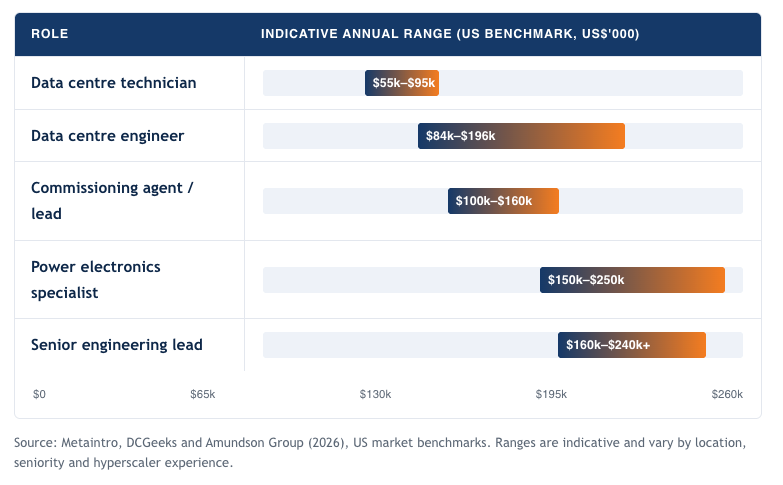
Compensation reflects the scarcity. The indicative US benchmark ranges below show why experienced professionals can command premium packages — and why operators increasingly compete on speed of offer as much as salary. In Gulf markets these figures translate into tax-advantaged packages with mobilisation, housing and international allowances layered on top.
05 — The Gap
A Structural Shortage, Not a Passing Squeeze
The data centre industry has faced skills shortages for more than a decade, and AI has widened the gap rather than closed it. Uptime Institute's 2025 global survey found that 46% of operators struggle to find qualified candidates and 37% struggle to retain the staff they have. Operations management is now the single most acute skills gap, cited by 39% of operators, while shortages in electrical and mechanical trades remain persistent.

The scarcity is compounded by mobility. Uptime found that 42% of operators have lost key staff to competitors offering 15–25% salary increases, particularly in the most active markets. Because experienced project managers, superintendents, MEP leaders and commissioning talent are typically already committed to live builds, the market can feel empty even when job postings are plentiful.
The transferable-skills advantage
Candidates with prior data centre experience remain highly prized — but the operators who win are those open to adjacent sectors. Power generation, industrial construction, oil & gas mobilisation and large-scale infrastructure all produce engineers who transfer effectively into mission-critical environments. Widening the lens is often the difference between a build that stays on schedule and one that slips.
06 — The Response
Why Workforce Planning Now Decides Project Outcomes
Successful recruitment begins long before construction starts. When electrical engineers, commissioning specialists and project managers can take 60 to 90 days to secure, the organisations that identify workforce requirements early — ideally during design and planning — engage talent ahead of competitors and materially reduce the risk of delay. In a market where every week of slippage can defer client onboarding and revenue, workforce planning has become a delivery discipline, not an HR afterthought.
The practical playbook is consistent across the strongest operators: build talent pipelines ahead of need rather than reacting to vacancies; lower unnecessary barriers to hiring and value equivalent experience alongside formal qualifications; assess rigorously so that scarce, expensive hires are the right ones; and maintain relationships with search partners who understand both the technical profile and the mobilisation logistics of moving engineers into the Gulf and other frontier markets.
The Outlook
As AI adoption deepens, demand for data centre infrastructure — and the talent to deliver it — is set to increase further, not level off. That will create sustained opportunity for engineering professionals and a persistent recruitment challenge for employers. The businesses best positioned to meet future demand will be those that treat talent as critical infrastructure in its own right: planned for early, sourced deliberately, and secured before the competition moves.
Verification & Confidence Note
Market-size figures differ between research houses because of varying scope (facilities vs. infrastructure vs. construction) and methodology; where estimates diverge, ranges are shown and the source named. Investment, capacity and power figures are forward projections and carry inherent uncertainty. Salary ranges are US-market benchmarks intended as directional indicators and will differ materially by geography, seniority and employer. All data was current as of publication (28 July 2026).
Important notice
General information only. This brief is published by STRAGO International for general information and market commentary purposes. It does not constitute professional, legal, financial, investment, employment or recruitment advice, and it should not be relied upon as the basis for any decision. Readers should obtain independent advice appropriate to their own circumstances before acting on any matter referred to here.

