

The gigawatt race: who can actually deliver the AI data centre build-out.

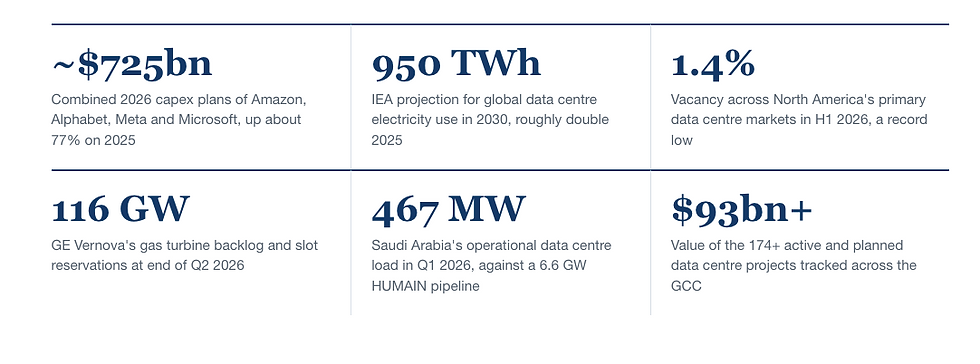
In 2026 the four largest US hyperscalers plan to spend roughly $725 billion on capital expenditure, most of it on AI data centres. Money is no longer the scarce input. Power, equipment, permits and specialist people are, and they are now deciding where capacity gets built and who gets paid to build it.
The capital is committed
The scale of spending is no longer in question. At the start of 2026 Amazon guided to around $200 billion of capex, Alphabet to $175–185 billion and Meta to $115–135 billion. Every one of them has since held or raised those numbers.
Meta lifted its range to $125–145 billion in the spring, citing higher component and construction costs. Microsoft's capex in its fiscal third quarter alone reached $30.9 billion, up 84% year on year. Across the four companies, 2026 plans now total roughly $725 billion, against about $410 billion in 2025 and $226 billion in 2024. Analyst consensus for 2027 already sits above $930 billion for the same four companies, and Goldman Sachs projects about $7.6 trillion of cumulative AI-related capex between 2026 and 2031.

The strain is visible in the cash flow. CreditSights estimates 2026 capex will absorb about 86% of Oracle's sales, 54% of Meta's, 47% of Microsoft's and 46% of Alphabet's. Alphabet's free cash flow turned negative in the second quarter of 2026 for the first time, and analysts expect Microsoft's to follow in the fourth quarter. Investors sold off hyperscaler shares after Alphabet raised its forecast again in July.
STRAGO view. A near-term pause is plausible if AI revenues lag, and equipment suppliers would feel it first because their order books are the most leveraged part of the chain. But the commitments already signed for turbines, transformers and pre-leased capacity run into 2028 and beyond. For anyone hiring to deliver projects, the pipeline of physical work through 2027 is largely locked in.
Power is the binding constraint
The International Energy Agency's latest update puts global data centre electricity use at about 485 TWh in 2025, roughly doubling to 950 TWh by 2030, or around 3% of world demand. Consumption from AI-focused facilities is expected to triple over the same period. In its base case the IEA sees demand reaching about 1,200 TWh by 2035.
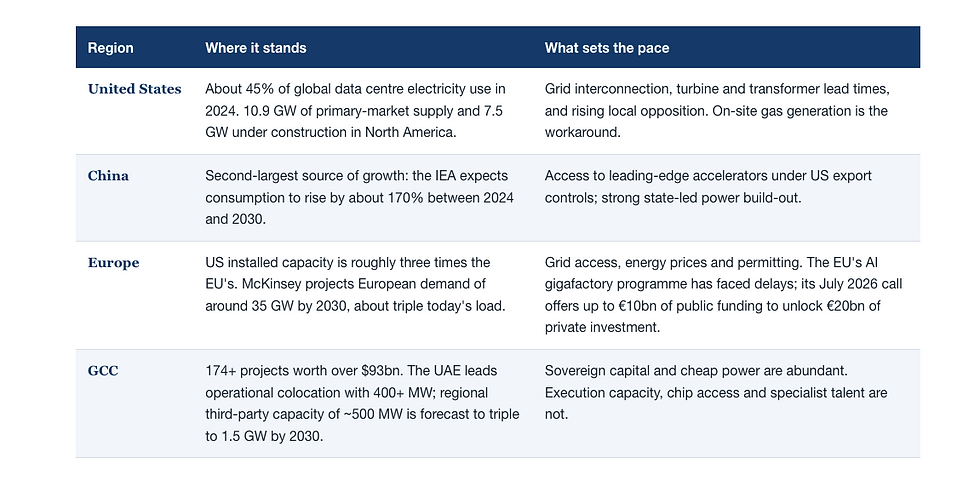
The growth is highly concentrated. Between 2024 and 2030 the IEA expects US data centre consumption to rise by around 240 TWh (up 130%) and China's by about 175 TWh (up 170%). Europe adds roughly 45 TWh (up 70%). By the end of the decade, the IEA expects US data centres to use more electricity than the country's entire production of aluminium, steel, cement and chemicals combined.
Grid connection, not land or capital, now sets the timetable. CBRE notes that 500 MW-plus AI campuses need multiple on-site substations, and where new high-voltage transmission or generation is required, interconnection can stretch to 24, 36 or even more than 48 months. The industry response has been to bring generation on site, overwhelmingly gas, and that has moved the bottleneck into turbine factories.

GE Vernova's own numbers show the imbalance. It ended the second quarter with 116 GW of gas equipment under contract or reserved and expects at least 125 GW by year end, while its factories are scaling towards roughly 20 GW of annual output this quarter and 30 GW by 2030. Siemens Energy closed its fiscal third quarter with a 69 GW gas turbine backlog, and Mitsubishi Heavy Industries reported about 35 GW. At current build rates, much of what is ordered today arrives in the next decade.
Electrical equipment is under similar pressure. GE Vernova's electrification unit booked more data centre orders in the first quarter of 2026 than in the whole of 2025, and its grid equipment backlog rose 69% year on year to $40.6 billion.
A race run at different speeds
The same constraints play out very differently by region. The result is a build-out that is global in demand but uneven in delivery.
The Gulf: from announcements to energised megawatts
The UAE has moved furthest. Stargate UAE, a 1 GW cluster within a planned 5 GW UAE–US AI Campus in Abu Dhabi, is being built by G42's Khazna Data Centers with OpenAI, Oracle, NVIDIA, Cisco and SoftBank. Its first 200 MW phase has been targeted for the third quarter of 2026, with more than 5,000 workers on site during construction. Microsoft has separately committed $7.9 billion to UAE AI and cloud infrastructure over 2026–2029, delivered through Khazna.
Saudi Arabia's ambitions are larger but earlier in delivery. HUMAIN, backed by the Public Investment Fund, targets 1.9 GW by 2030 and 6.6 GW by 2034, at an estimated cost of around $77 billion. The Ministry of Communications and IT reported 467 MW of operational data centre capacity in Q1 2026.

That gap is not a criticism; it is the opportunity. Every megawatt between the white bars and the orange ones has to be designed, energised, commissioned and operated by people who largely do not yet exist in the local market.
Sovereignty moved from slogan to operating risk
Two events this summer showed how much of the AI stack depends on decisions made in Washington.
On 12 June 2026, the US Department of Commerce applied export controls to Anthropic's Claude Fable 5 and Mythos 5 models, requiring the company to restrict access by foreign nationals. Unable to verify nationality in real time, Anthropic suspended both models for all users worldwide. The controls were lifted on 30 June and access was restored from 1 July. The episode lasted less than three weeks, but it demonstrated that access to frontier AI can be withdrawn with no notice.
Weeks later, the opposite happened for the UAE. From 10 July 2026, the Bureau of Industry and Security moved the country into Country Group A:5, its most trusted export tier, allowing G42, Core42 and approved US companies operating in the UAE to receive advanced AI chips without individual licences. Saudi Arabia was not included; HUMAIN continues to buy under a case-by-case authorisation equivalent to up to 35,000 NVIDIA GB300 accelerators.
The constraint nobody puts in the model: people
Power and equipment dominate the headlines, but delivery teams feel a more immediate shortage. Industry surveys consistently find that more than half of data centre operators struggle to fill qualified technical roles. In the UK, every respondent to Turner & Townsend's August 2026 survey reported shortages of mechanical, electrical and plumbing workers, and labour availability has overtaken material costs as the main driver of construction inflation. Microsoft's president has publicly named the electrician shortage as a major obstacle to the company's US expansion.
The hardest roles to fill are the ones at the end of the programme, where there is no float left: commissioning engineers and managers, high-voltage authorised persons, controls and BMS specialists, liquid-cooling and critical-facility operations leads, and project directors who have already handed over a live hyperscale facility.
In the Gulf the challenge compounds. Gigawatt campuses are arriving in markets without a deep local base of data centre specialists, at the same time as national workforce programmes raise the bar for localisation. Projects need to import proven expertise quickly, keep it through commissioning and transfer knowledge to national talent, all while competing with the US and Europe for the same few thousand senior specialists.
What this means for ecosystem participants
Developers and operators
Secure people as early as power. Operations leadership and commissioning teams should be mobilised during construction, not recruited at handover. Retention through energisation is now a programme risk.
EPCs and MEP contractors
Labour, not materials, is setting bid prices and schedules. Firms with a mobile, pre-vetted bench of HV, controls and commissioning specialists can take on work others must decline.
OEMs and the supply chain
Backlogs extending to 2030–2031 create demand for field service, installation and site-acceptance engineers in every new market, including regions where OEMs have no established footprint.
Investors
Diligence should test delivery capability as closely as power and offtake. A project with land and a grid position but no credible team to commission it is a slower asset than its model suggests.
Governments and sovereign programmes
Capital and chips are only part of the equation. Localisation targets work best when paired with structured knowledge transfer from experienced international hires.
Frontier and emerging markets
As core hubs run out of power, capacity will follow energy into new jurisdictions across the Gulf, North Africa and East Africa, where both regulatory navigation and in-country workforce support matter.
Build the team that delivers the megawatts
STRAGO's Digital Infrastructure & Data Centres practice recruits the senior technical and leadership talent that AI campuses depend on, from commissioning and HV specialists to critical operations directors, across the GCC and frontier markets.
Important notice
General information only. This brief is published by STRAGO International for general information and market commentary purposes. It does not constitute professional, legal, financial, investment, employment or recruitment advice, and it should not be relied upon as the basis for any decision. Readers should obtain independent advice appropriate to their own circumstances before acting on any matter referred to here.
